
arrow_upward

Jerzy Ros

The Sphinx [Sfinks]

YEAR: 1968

COUNTRY: Poland

chat Submit error

Cateogry icon

Title of the work

The Sphinx [Sfinks]

Country of the First Edition

Country/countries of popularity

Poland

Original Language

Polish

First Edition Date

1968

First Edition Details

Jerzy Ros, “Sfinks”, Dookoła świata 15 (1968): 15–16.

ISBN

ISSN: 0012-5458

Official Website

https://www.dookolaswiata24.pl/ (accessed: March 20, 2026).

Genre

Short stories

Target Audience

Crossover (teenagers, young adults)

Cover
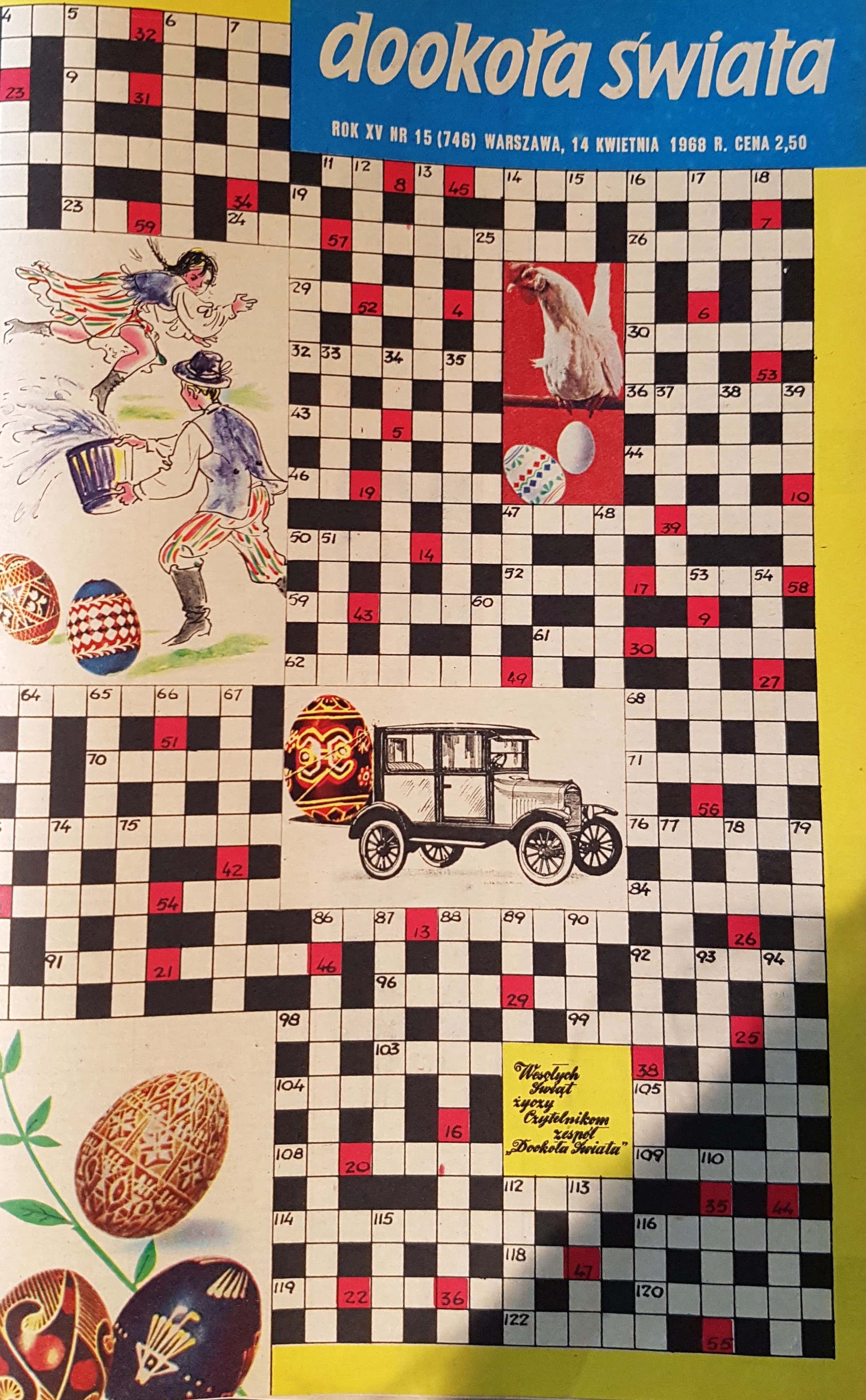
Courtesy of Dookoła świata editors.


Author of the Entry:

Marta Pszczolińska, University of Warsaw, m.pszczolinska@al.uw.edu.pl

Peer-reviewer of the Entry:

Katarzyna Marciniak, University of Warsaw, kamar@al.uw.edu.pl 

Elżbieta Olechowska, University of Warsaw, elzbieta.olechowska@gmail.com
Male portrait

Jerzy Ros , 1919 - 1997
(Author)

Jerzy Ros (1919–1997) was a Polish journalist, reporter, traveller, writer, translator and diplomat. Ros was born in Warsaw in a Jewish family, Rosenberg, decimated during WWII; his parents and sisters died as victims of Nazi genocide. He participated in the Warsaw Ghetto Uprising in 1943, and later was imprisoned in ten Nazi forced labour or concentration camps, including Majdanek, Auschwitz, Sachsenhausen, and Dachau. On the day of victory, in a state of extreme starvation, he was taken from an evacuation transport to a hospital. He later became the press spokesman and head of the press office for the first Polish-German judicial site inspection at the site of the former Nazi concentration camp in Auschwitz, which was ordered there by the Frankfurt am Main court and attended by dozens of foreign journalists, including some from Israel.

After the war, Ros worked as a journalist for several newspapers (e.g., Życie Warszawy) and magazines (mainly Dookoła świata) until 1956. Subsequently, he worked at the Polish embassy in Washington as cultural and press attaché (1956–1960) and after his return to Poland, at the Ministry of Foreign Affairs. Since 1965, he left the Ministry and devoted himself full-time to journalism and writing. He authored many short stories on topics related to concentration camps, as well as historical books, adventure novels for children and young adults, and travel books. He gained popularity with his collection of reportages Indyjskie wędrówki [Indian Wanderings], as well as Heroje Północy [Heroes of the North] – stories based on Scandinavian mythology – and volumes of adventure stories and fairy tales from around the world. In 1969, he emigrated with his family to Israel, and eventually, to the United States.

His books include: Indyjskie wędrówki (1957), Kalif tak chce. Bajki z 1001 dnia [The caliph wills it. Fairy tales of 1001 days] (1957), Tajemnice arrasowego skarbu [Secrets of the tapestry treasure] (1963), Podróże z Abrakadabrą [Travels with Abracadabra] (1965), Rafa trzech szkieletów [The reef of three skeletons] (1967), Heroje Północy (1969), Uśmiech rekina [Shark’s smile] (1989).


Sources:

[Kosmalska, Agata], Dookoła Świata Nr 1/1954 at Dookoła świata official website (accessed: March 17, 2026). 

[Polskie Radio], “Niemcom nie przebaczamy”. Ta nagonka zaczęła się 60 lat temu and the audio file [PR1] PR1 (mp3) 22 listopad 2015 06_14_32.cz1.mp3 part 1 (accessed: March 17, 2026).

[Ros, Jerzy], Relacje Ros Jerzy [Testimony of Jerzy Ros], 301/43, Centralna Biblioteka Judaistyczna, and Delet portal, Żydowski Instytut Historyczny (The Emanuel Ringelblum Jewish Historical Institute), (accessed: March 17, 2026). 

[Ros, Jerzy], Testimony of Jerzy Rosenberg Ros, born in Warsaw, Poland, 1919, regarding his experiences in the Warsaw Ghetto, Poniatowa, Majdanek, Starachowice and other places, Yad Vashem testimonies 3440 (accessed: March, 17, 2026).


Bio prepared by Marta Pszczolińska, University of Warsaw, m.pszczolinska@al.uw.edu.pl


Summary

Scientists gather at the international convention organised by the Royal Archaeological Society. Not only archaeologists were invited, but also representatives of biochemistry, medicine, pharmacology, and law. The president opens the convention by briefly introducing an Egyptologist and a neurosurgeon standing next to him, and promises to explain the reason for bringing together such an unusual combination of disciplines pointing to a mysterious object covered with a white sheet. 

The Egyptologist recounts how, during excavations of a temple of Seth in Egypt, his team found a stone chest sealed with wax and resin, and a single papyrus scroll inside. The text in the scroll was a kind of scientific testament written by a priest-physician who had worked as an embalmer in a House of the Dead for many years. There, he conducted his first experiments in inter-species organ transplantation between humans and animals, until he was discovered by the priestly collegium and exiled to a distant temple of Seth, where the scroll was found. The next section of the papyrus was a diary of transplants and an explanation of the origin of a hybrid creature called Sphinx. The priest attempted to bring to life the images of ancient Egyptian gods: Horus and Seth. His attempts failed, so he decided to transplant the head of a priestess onto the body of a lioness. This experiment was described as successful. As the manuscript provided methodological indications and a report on the transplantation process, the archaeological group asked neurologists to confirm or debunk the author’s knowledge of anatomy and neurosurgery. The knowledge and the experiment were assessed as reliable, which led to the idea of its recreation.

The second scientist, neurosurgeon, confirms that not only was the procedure feasible, but also decision was made to recreate it. The lioness chosen for the experiment was fed according to the prescribed regimen, and the human head was supposed to be taken from someone who had died in an accident and was beyond help. Every step of the process was to be recreated from the manuscript, including the use of original Egyptian herbs and even magic formulas. The body eventually obtained for the experiment belonged to a young prostitute addicted to alcohol, whose death was caused by stabbing. The transplant succeeded. Having given the audience this explanation, the scientist approaches the mysterious shape and removes the covering sheet from the chest. 

Inside lies the body of a lioness with the head of a peroxide blonde: a Sphinx, temporarily blinded by the bright lights. After a while of absolute silence, the big cat rises up and looks at the gathering, seeing men only. Suddenly, in a whisky voice, the creature, apparently greeting them, asks: ‘How are you doing, lads? Well, which one of you is going to buy me a drink?’.

Analysis

Ros sent this short story to the editorial team to contribute to the international discussion on organ transplantation and its moral, legal, medical and theological aspects. It is worth noting, that he was painfully aware of the horror of experiments on human beings, having witnessed the murderous, genocidal research conducted on prisoners of Auschwitz concentration camp by Josef Mengele.

Instead of writing an essay on transplantology, he wrote an “archaeological” short story as a means to express his attitude towards this complex issue at a time, when in Poland, the discipline was still in its infancy (the first successful kidney transplant took place in 1966 and the first successful heart transplant in 1985).

The mythical Sphinx has been chosen as the symbolic hybrid creature. In fact, the author has made the creature not only an animal-human hybrid, but also a hybrid of various characteristics, including Egyptian and Greek. Although the author chose an ancient Egyptian setting as the background for his story, the image of his protagonist is not exactly rooted in Egyptian culture. Typically, Egyptian sphinxes are representations of male rulers, regarded as strong, noble, and benevolent, often wearing royal headcloths. The only instance of a woman being sculpted as a sphinx was the pharaoh Hatshepsut. In Ros’ story, however, the sphinx created by the ancient priest is not intended to commemorate the pharaoh. The only reason for creating a female sphinx was the failure to achieve the priest’s primary goal, recreating the image of the gods (depicted as men with the heads of wolves and eagles). It led the priest to seek another solution, creating a fully female hybrid using the head of a seer priestess who had been bitten by a snake, a sign of god’s punishment. Thus, for the priest, the female hybrid is not equal to the ‘divine’ one that he intended at first, but in fact the lesser option involving a woman who offended the gods and was seen as a lower-category human. Modern imitators of the procedure faced a similar situation. The only head available for the experiment belonged to a prostitute: a despised and socially marginalised individual, whose only value for them was being a ‘donor’. 

The sphinx in the story has more in common with the Greek Sphinx than with the Egyptian ones, although not all features align. Born into a family of strange, monstrous creatures (such as Cerberus, the Hydra and the Chimaera), the Greek predecessor was undoubtedly female and a combination of more than two species, having the body of a lioness, the head of a woman and strong wings. She could talk and could engage people in a discussion, posing them a mental task of answering riddles According to Apollodorus, the Thebans “were in possession of an oracle which declared that they should be rid of the Sphinx whenever they had solved the riddle; so they often met and discussed the answer, and when they could not find it the Sphinx used to snatch away one of them and gobble him up.”* The story reflects the gatherings of Theban men deliberating on the solution – scientists gather around the Sphinx, all are male and all contemplate her mysterious appearance. They are potential victims of her paws and predatory instincts, which heightens the tension. Despite the comic effect of the contrast between their elegant convention and her rude words, they are all in danger because of her existence. The situation alludes to the myth of the tragically cursed royal house of the Labdacidae and its toxic influence on the Theban society. Here, the decision to re-enact ancient procedures without thinking through the consequences and sinister ethical dimensions shows the danger as well as the absurd of allowing potential excesses of science unbridled by morality and common sense.


* Lib. 3.5.8, trans. James George Frazer.

χρησμοῦ δὲ Θηβαίοις ὑπάρχοντος τηνικαῦτα ἀπαλλαγήσεσθαι τῆς Σφιγγὸς ἡνίκα ἂν τὸ αἴνιγμα λύσωσι, συνιόντες εἰς ταὐτὸ πολλάκις ἐζήτουν τί τὸ λεγόμενόν ἐστιν, ἐπεὶ δὲ μὴ εὕρισκον, ἁρπάσασα ἕνα κατεβίβρωσκε.


Addenda

The entry presents the result of research conducted within the project “Classical Antiquity in Periodicals for Children and Young Adults in Polish People’s Republic (PRL) – Classical Education, Promotion of Political Ideology, or Expression of Resistance? Changes in the Reception of Classics in the PRL from 1945 to 1989,” funded by the National Science Centre (Narodowe Centrum Nauki) Preludium grant no. 2022/45/N/HS2/00549, and led by Marta Pszczolińska at the Faculty of “Artes Liberales” at the University of Warsaw.


Yellow cloud
Leaf pattern
Leaf pattern

Title of the work

The Sphinx [Sfinks]

Country of the First Edition

Country/countries of popularity

Poland

Original Language

Polish

First Edition Date

1968

First Edition Details

Jerzy Ros, “Sfinks”, Dookoła świata 15 (1968): 15–16.

ISBN

ISSN: 0012-5458

Official Website

https://www.dookolaswiata24.pl/ (accessed: March 20, 2026).

Genre

Short stories

Target Audience

Crossover (teenagers, young adults)

Cover

Courtesy of Dookoła świata editors.


Author of the Entry:

Marta Pszczolińska, University of Warsaw, m.pszczolinska@al.uw.edu.pl

Peer-reviewer of the Entry:

Katarzyna Marciniak, University of Warsaw, kamar@al.uw.edu.pl 

Elżbieta Olechowska, University of Warsaw, elzbieta.olechowska@gmail.com

Male portrait

Jerzy Ros (Author)

Jerzy Ros (1919–1997) was a Polish journalist, reporter, traveller, writer, translator and diplomat. Ros was born in Warsaw in a Jewish family, Rosenberg, decimated during WWII; his parents and sisters died as victims of Nazi genocide. He participated in the Warsaw Ghetto Uprising in 1943, and later was imprisoned in ten Nazi forced labour or concentration camps, including Majdanek, Auschwitz, Sachsenhausen, and Dachau. On the day of victory, in a state of extreme starvation, he was taken from an evacuation transport to a hospital. He later became the press spokesman and head of the press office for the first Polish-German judicial site inspection at the site of the former Nazi concentration camp in Auschwitz, which was ordered there by the Frankfurt am Main court and attended by dozens of foreign journalists, including some from Israel.

After the war, Ros worked as a journalist for several newspapers (e.g., Życie Warszawy) and magazines (mainly Dookoła świata) until 1956. Subsequently, he worked at the Polish embassy in Washington as cultural and press attaché (1956–1960) and after his return to Poland, at the Ministry of Foreign Affairs. Since 1965, he left the Ministry and devoted himself full-time to journalism and writing. He authored many short stories on topics related to concentration camps, as well as historical books, adventure novels for children and young adults, and travel books. He gained popularity with his collection of reportages Indyjskie wędrówki [Indian Wanderings], as well as Heroje Północy [Heroes of the North] – stories based on Scandinavian mythology – and volumes of adventure stories and fairy tales from around the world. In 1969, he emigrated with his family to Israel, and eventually, to the United States.

His books include: Indyjskie wędrówki (1957), Kalif tak chce. Bajki z 1001 dnia [The caliph wills it. Fairy tales of 1001 days] (1957), Tajemnice arrasowego skarbu [Secrets of the tapestry treasure] (1963), Podróże z Abrakadabrą [Travels with Abracadabra] (1965), Rafa trzech szkieletów [The reef of three skeletons] (1967), Heroje Północy (1969), Uśmiech rekina [Shark’s smile] (1989).


Sources:

[Kosmalska, Agata], Dookoła Świata Nr 1/1954 at Dookoła świata official website (accessed: March 17, 2026). 

[Polskie Radio], “Niemcom nie przebaczamy”. Ta nagonka zaczęła się 60 lat temu and the audio file [PR1] PR1 (mp3) 22 listopad 2015 06_14_32.cz1.mp3 part 1 (accessed: March 17, 2026).

[Ros, Jerzy], Relacje Ros Jerzy [Testimony of Jerzy Ros], 301/43, Centralna Biblioteka Judaistyczna, and Delet portal, Żydowski Instytut Historyczny (The Emanuel Ringelblum Jewish Historical Institute), (accessed: March 17, 2026). 

[Ros, Jerzy], Testimony of Jerzy Rosenberg Ros, born in Warsaw, Poland, 1919, regarding his experiences in the Warsaw Ghetto, Poniatowa, Majdanek, Starachowice and other places, Yad Vashem testimonies 3440 (accessed: March, 17, 2026).


Bio prepared by Marta Pszczolińska, University of Warsaw, m.pszczolinska@al.uw.edu.pl


Summary

Scientists gather at the international convention organised by the Royal Archaeological Society. Not only archaeologists were invited, but also representatives of biochemistry, medicine, pharmacology, and law. The president opens the convention by briefly introducing an Egyptologist and a neurosurgeon standing next to him, and promises to explain the reason for bringing together such an unusual combination of disciplines pointing to a mysterious object covered with a white sheet. 

The Egyptologist recounts how, during excavations of a temple of Seth in Egypt, his team found a stone chest sealed with wax and resin, and a single papyrus scroll inside. The text in the scroll was a kind of scientific testament written by a priest-physician who had worked as an embalmer in a House of the Dead for many years. There, he conducted his first experiments in inter-species organ transplantation between humans and animals, until he was discovered by the priestly collegium and exiled to a distant temple of Seth, where the scroll was found. The next section of the papyrus was a diary of transplants and an explanation of the origin of a hybrid creature called Sphinx. The priest attempted to bring to life the images of ancient Egyptian gods: Horus and Seth. His attempts failed, so he decided to transplant the head of a priestess onto the body of a lioness. This experiment was described as successful. As the manuscript provided methodological indications and a report on the transplantation process, the archaeological group asked neurologists to confirm or debunk the author’s knowledge of anatomy and neurosurgery. The knowledge and the experiment were assessed as reliable, which led to the idea of its recreation.

The second scientist, neurosurgeon, confirms that not only was the procedure feasible, but also decision was made to recreate it. The lioness chosen for the experiment was fed according to the prescribed regimen, and the human head was supposed to be taken from someone who had died in an accident and was beyond help. Every step of the process was to be recreated from the manuscript, including the use of original Egyptian herbs and even magic formulas. The body eventually obtained for the experiment belonged to a young prostitute addicted to alcohol, whose death was caused by stabbing. The transplant succeeded. Having given the audience this explanation, the scientist approaches the mysterious shape and removes the covering sheet from the chest. 

Inside lies the body of a lioness with the head of a peroxide blonde: a Sphinx, temporarily blinded by the bright lights. After a while of absolute silence, the big cat rises up and looks at the gathering, seeing men only. Suddenly, in a whisky voice, the creature, apparently greeting them, asks: ‘How are you doing, lads? Well, which one of you is going to buy me a drink?’.

Analysis

Ros sent this short story to the editorial team to contribute to the international discussion on organ transplantation and its moral, legal, medical and theological aspects. It is worth noting, that he was painfully aware of the horror of experiments on human beings, having witnessed the murderous, genocidal research conducted on prisoners of Auschwitz concentration camp by Josef Mengele.

Instead of writing an essay on transplantology, he wrote an “archaeological” short story as a means to express his attitude towards this complex issue at a time, when in Poland, the discipline was still in its infancy (the first successful kidney transplant took place in 1966 and the first successful heart transplant in 1985).

The mythical Sphinx has been chosen as the symbolic hybrid creature. In fact, the author has made the creature not only an animal-human hybrid, but also a hybrid of various characteristics, including Egyptian and Greek. Although the author chose an ancient Egyptian setting as the background for his story, the image of his protagonist is not exactly rooted in Egyptian culture. Typically, Egyptian sphinxes are representations of male rulers, regarded as strong, noble, and benevolent, often wearing royal headcloths. The only instance of a woman being sculpted as a sphinx was the pharaoh Hatshepsut. In Ros’ story, however, the sphinx created by the ancient priest is not intended to commemorate the pharaoh. The only reason for creating a female sphinx was the failure to achieve the priest’s primary goal, recreating the image of the gods (depicted as men with the heads of wolves and eagles). It led the priest to seek another solution, creating a fully female hybrid using the head of a seer priestess who had been bitten by a snake, a sign of god’s punishment. Thus, for the priest, the female hybrid is not equal to the ‘divine’ one that he intended at first, but in fact the lesser option involving a woman who offended the gods and was seen as a lower-category human. Modern imitators of the procedure faced a similar situation. The only head available for the experiment belonged to a prostitute: a despised and socially marginalised individual, whose only value for them was being a ‘donor’. 

The sphinx in the story has more in common with the Greek Sphinx than with the Egyptian ones, although not all features align. Born into a family of strange, monstrous creatures (such as Cerberus, the Hydra and the Chimaera), the Greek predecessor was undoubtedly female and a combination of more than two species, having the body of a lioness, the head of a woman and strong wings. She could talk and could engage people in a discussion, posing them a mental task of answering riddles According to Apollodorus, the Thebans “were in possession of an oracle which declared that they should be rid of the Sphinx whenever they had solved the riddle; so they often met and discussed the answer, and when they could not find it the Sphinx used to snatch away one of them and gobble him up.”* The story reflects the gatherings of Theban men deliberating on the solution – scientists gather around the Sphinx, all are male and all contemplate her mysterious appearance. They are potential victims of her paws and predatory instincts, which heightens the tension. Despite the comic effect of the contrast between their elegant convention and her rude words, they are all in danger because of her existence. The situation alludes to the myth of the tragically cursed royal house of the Labdacidae and its toxic influence on the Theban society. Here, the decision to re-enact ancient procedures without thinking through the consequences and sinister ethical dimensions shows the danger as well as the absurd of allowing potential excesses of science unbridled by morality and common sense.


* Lib. 3.5.8, trans. James George Frazer.

χρησμοῦ δὲ Θηβαίοις ὑπάρχοντος τηνικαῦτα ἀπαλλαγήσεσθαι τῆς Σφιγγὸς ἡνίκα ἂν τὸ αἴνιγμα λύσωσι, συνιόντες εἰς ταὐτὸ πολλάκις ἐζήτουν τί τὸ λεγόμενόν ἐστιν, ἐπεὶ δὲ μὴ εὕρισκον, ἁρπάσασα ἕνα κατεβίβρωσκε.


Addenda

The entry presents the result of research conducted within the project “Classical Antiquity in Periodicals for Children and Young Adults in Polish People’s Republic (PRL) – Classical Education, Promotion of Political Ideology, or Expression of Resistance? Changes in the Reception of Classics in the PRL from 1945 to 1989,” funded by the National Science Centre (Narodowe Centrum Nauki) Preludium grant no. 2022/45/N/HS2/00549, and led by Marta Pszczolińska at the Faculty of “Artes Liberales” at the University of Warsaw.
Yellow cloud