
Title of the work
Country of the First Edition
Country/countries of popularity
Original Language
First Edition Date
First Edition Details
Jerzy Jesionowski, “Siódma wyprawa”, Płomyczek 1–6 (1974): 18–23, 54–58, 82–86, 117–122, 147–151, 170–174.
ISBN
Awards
The puppet play entitled A Fairy Tale about a New Hero received an award in a competition for puppet theatre organised in 1963 by the Ministry of Culture and Art and the Capital City National Council in agreement with the Polish Writers’ Union.
Genre
Science fiction
Short stories
Target Audience
Children (9–11 y.o.)
Cover
We are still trying to obtain permission for posting the original cover.
Author of the Entry:
Marta Pszczolińska, University of Warsaw, m.pszczolinska@al.uw.edu.pl
Peer-reviewer of the Entry:
Katarzyna Marciniak, University of Warsaw, kamar@al.uw.edu.pl
Elżbieta Olechowska, University of Warsaw, elzbieta.olechowska@gmail.com
Waldemar Andrzejewski
, 1934 - 1993
(Illustrator)
Waldemar Andrzejewski (1934–1993) was Polish graphic artist, illustrator, comic book artist, poster and stamp designer. After graduating in Graphic Arts from Academy of Fine Arts in Warsaw, he designed book covers and illustrated popular works of children’s prose, standalone books, as well as texts in magazines for young readers, especially for “Nasza Księgarnia” [Our Bookstore] publishing house. He also authored comic books – he produced adaptations of well known SF novels, such as for example The Time Machine and The War of the Worlds by H. G. Wells or Captain Nemo based on 20000 Leagues Under the Sea by Jules Verne.
Sources:
Waldemar Andrzejewski at desa.pl (accessed: March 17, 2026).
Wikipedia.pl (accessed: March 17, 2026).
Bio prepared by Marta Pszczolińska, University of Warsaw, m.pszczolinska@al.uw.edu.pl
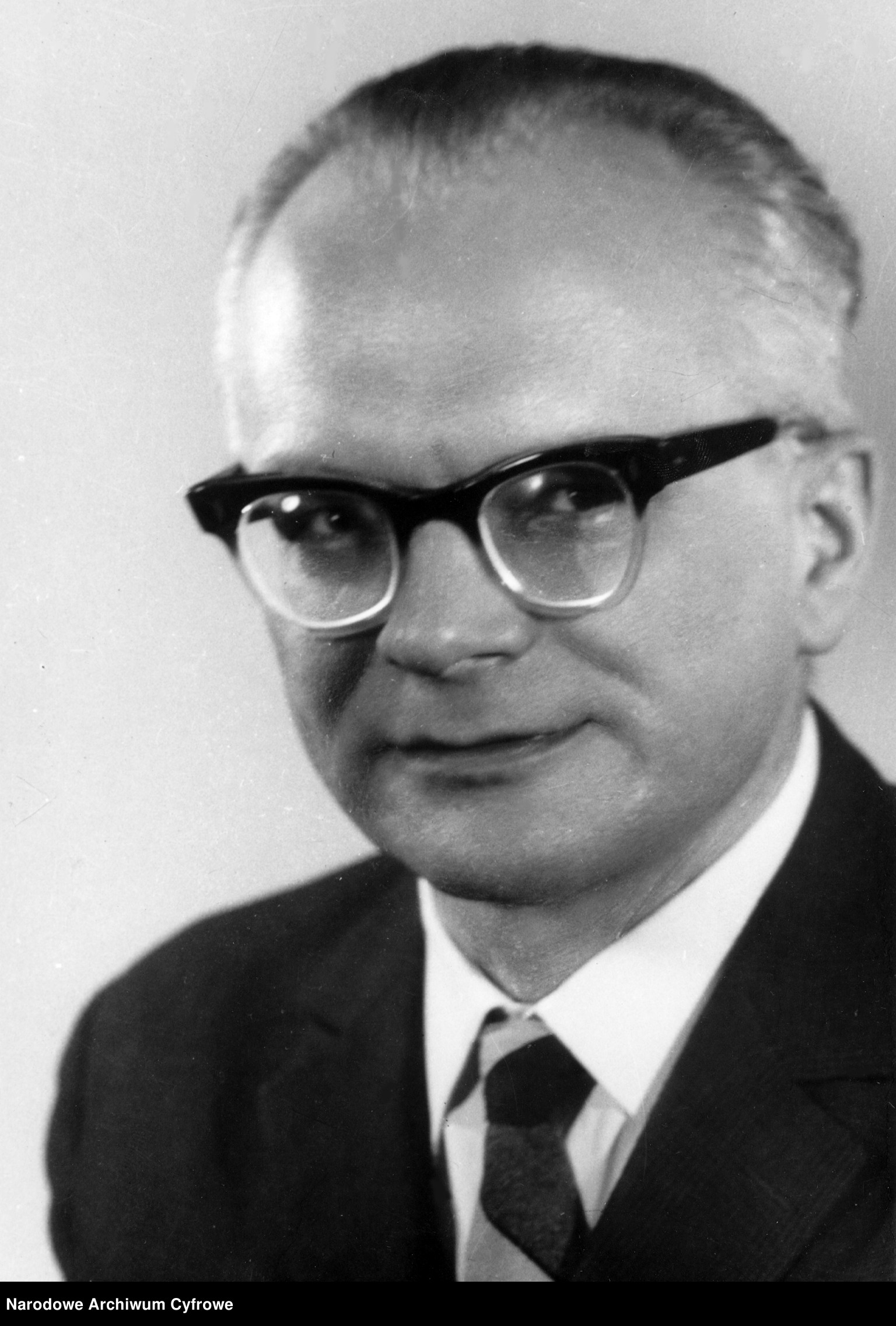
Retrieved from Narodowe Archiwum Cyfrowe 3/20/0/-/53 (accessed: March 17, 2026).
Jerzy Jesionowski
, 1919 - 1992
(Author)
Jerzy Jesionowski was a poet, prose writer, and playwright. He also wrote rhymes, short stories, novels and plays for children. Although he graduated from the Faculty of Mechanical Engineering at the Warsaw University of Technology and the Faculty of Philosophy at the University of Warsaw, his main interest was literature. He began publishing as a secondary school student in 1934, and continued writing after WWII. Member of the Polish United Workers’ Party (PZPR) since 1958, he joined the Polish Writers’ Union in 1961. He held high managerial positions at the Polish Radio in 1965–1969, was the artistic director of the Film Studio “Wektor” in 1969–1971; in 1983 he was appointed president of the newly created Literary Fund Council at the Ministry of Culture and Art; in 1985–1990, he held the position of Deputy President of the renewed Union of Polish Writers; in 1986, he was appointed to the Social and Economic Council of the Polish Parliament. Between 1958 and 1985, he was awarded many prizes for his plays, screenplays, and novels by the communist authorities.
Sources:
Jesionowski Jerzy at Polscy pisarze i badacze literatury XX i XXI wieku. Cyfrowy słownik biobibliograficzny (accessed: March 17, 2026).
Jerzy Jesionowski at Encyklopedia fantastyki (accessed: March 17, 2026).
Bio prepared by Marta Pszczolińska, University of Warsaw, m.pszczolinska@al.uw.edu.pl
Adaptations
The text is an adaptation of a puppet play.
The premiere of the play entitled Prawdziwy czarnoksiężnik czyli siódma wyprawa kosmonautów [The True Sorcerer, or the Seventh Expedition of the Cosmonauts] was staged in Łódź, Teatr Lalek „Arlekin” in 1963.
Staged under the title Wyprawa po zielony metal [The Quest for the Green Metal], in Teatr Klasyczny in Warsaw – Scena młodzieżowa, Pałac Kultury i Nauki, dir. by Zbigniew Sawan, premiere 19 Dec. 1964; Wrocławski Teatr Lalek in Wrocław, dir. Wiesław Hejno, premiere 24 Sept. 1972; Teatr Polski in Szczecin, dir. Ewa Kołogórska, premiere 5 Nov. 1976; Teatr Ziemi Pomorskiej in Grudziądz, dir. Janusz Kozłowski, premiere 3 Dec. 1978.
Staged as: Siódma wyprawa [The Seventh Expedition], Teatr Lalek “Groteska in Kraków, dir. Franciszek Puget, premiere 11 Sept. 1965.
Staged as Das Grüne Metall, Mecklenburgisches Staatstheater Schwerin, dir. Wolfgang Böttcher, premiere 14 June 1971.
Also staged as: Baśń o nowym bohaterze; Rycerz kosmosu; Baśń o rycerzach kosmosu.
The play was subsequently published as „Wyprawa po zielony metal. (Sztuka dla dzieci na żywy lub lalkowy plan)” in Teatr Ludowy 4 (1969), pull-out p. 3–22.
It has also been published in Jerzy Jesionowski, Zielony metal i zielona głowa : dwa utwory sceniczne dla starszych dzieci, [Warszawa]: Ludowa Spółdzielnia Wydawnicza, 1972, 120 pp.
Translation
German: Das Grüne Metall, [unknown trans.], for Mecklenburgisches Staatstheater Schwerin, 1971.
Summary
The queen’s daughter, Aurelia, is severely ill. Her condition is caused by a germ from outer space. The only possible cure requires an ingredient that is extremely rare: a powdered green metal, only found on a planet called Oktawia. Of the six expeditions sent there, five failed to land on the planet, and the sixth disappeared without trace. With the help of the Institute of All Time, which can bring into the present day anyone who has ever lived on Earth, three men volunteer to embark on the quest: two ancient heroes, Hercules and Achilles, and a frail scientist, called the Doctor. In exchange for his participation, Achilles demands command of the expedition and the title of crown prince; Hercules wants to be rewarded with sack of gold; and the Doctor asks for the rest of the surplus of the green metal. The queen agrees. The pilot and the queen’s secretary, who is acting as narrator, also join the crew.
The Doctor proves his usefulness to the quest by solving technical problems during the landing. Upon reaching the surface, the heroes encounter an Oktawian who requires energy. Doctor suggests charging the alien at a nearby electric power station. This works, and in gratitude the alien advises that they should retreat. The green metal is so rare that the ruler will not want to grant it. Achilles orders Hercules to capture someone who could give them the location of the mine. Hercules tries to overpower an alien but is hit by an electrical charge. The next attempt is made by Achilles himself, as he cannot be vanquished. He withstands the electroshock, but the discharge weakens his opponent, who unfortunately, provides no information.
A human appears. He is the sole survivor of the sixth expedition. Before he has time to regain his life force, a large group of Oktawians arrives to arrest Achilles for attacking one of them. This time, he cannot deal with so many opponents attacking simultaneously from all directions. Achilles is hit in the heel, disarmed, taken away, and charged with attempted assault. The Doctor, the brains of the expedition, decides that they should visit the Headmaster of the Oktawians instead of trying another fight. In order to have a chance of getting into the palace, meeting the Headmaster and freeing Achilles, Doctor plans to present himself and his companions as a sorcerer with his assistants. To prove his ‘magical’ powers, Doctor uses his tape recorder, an invention unknown in Oktawia. The Headmaster and his daughter are astonished when they hear their own voices and some dance music. Doctor therefore proposes a trade: the tape recorder for Achilles and some green metal. The Headmaster agrees to free Achilles, but the green metal is too precious to trade. Instead, he promises it in exchange for the sorcerer services – three trials that only sorcerers can handle.
The first task seems quite easy: retrieve the ruler’s wreath that fell into the well. Unfortunately, a terrifying lizard lives there which cannot be killed, as it is a sacred animal protected by local law. Hercules suggests using his force as the solution, but clever Doctor achieves their goal without fighting. Once the first task is complete, Achilles is freed. However, the warrior is too proud to acknowledge Doctor as the commander and sorcerer. He exposes him as an impostor, and they are all put in chains.
Hercules easily breaks the chains, and Doctor asks the Headmaster for the second task in which everyone can win what they need. The task is to get rid of a purple bird that devours sheep. During the fight, Hercules is taken to the nest, and it is Doctor again who uses his intelligence to defeat the bird and to free Hercules from the rocky mountain.
The third task is a duel with the court sorcerer. The Doctor and the sorcerer are expected to ask five questions each and answer them correctly. The Doctor wins because the questions require wit and out-of-the-box thinking. The Headmaster orders that the green metal be given to the Earthlings. Unfortunately for the Oktawians, Hercules is allowed to carry as much as he can and he does, leaving them astonished by his strength once again. The expedition returns and the royal princess is healed. The queen asks the Doctor why he needs the metal. He replies that he wants to help many other people on Earth, and not just the queen’s daughter.
Analysis
Despite the space travel setting, references to classical antiquity are numerous and relevant. The author brings up classical antiquity in two ways. Firstly, he introduces two Greek demigods as the main characters – mythical beings capable of succeeding in an impossible quest. Secondly, Achilles and Hercules make multiple references to the mythical past they come from, for instance by calling upon Zeus or mentioning their heroic deeds.
In the story, Achilles is the first of two ancient heroes to appear. Wearing full armour and carrying a sword, he embodies the image of the greatest mythical warrior. He seems aware and very proud of his fame, which is most precious to him. Although he has a good knowledge of royal protocol and etiquette, he is not a noble knight who practices chivalry; he demands that the queen make him her heir if the expedition is successful. He also expects to lead the expedition, considering himself the most competent and famous candidate. Curiously, Hercules has clearly never heard of Achilles or his mythical abilities and fame. For his part, Achilles does not acknowledge Hercules as a great hero and son of Zeus, but treats him as a lesser being, calling him with contempt a ‘dumb muscleman’. In general, his excessive pride makes him feel so self-important that he shows contempt for everyone. However, it becomes apparent soon, that it is Doctor, who is the brains of the team, as Achilles’ modus operandi is fighting and violence. Achilles prefers to act and attack rather than use his wit and cunning. First and foremost, he is a fierce and brave warrior. He openly admits that all his victories were the result of successful assault and relentless fight. Therefore, it is difficult to convince him that force may not always be the right option. Even when confronted with an overwhelming electrical charge emitted by an alien, he endures the pain to exhaust the alien’s powers and win. When he is freed from imprisonment thanks to the Doctor’s intervention, he still has no respect for the Doctor (a feeble civilian) and ignores his attempts to find solutions in which he, the great Achilles, is no longer the leader. Imprisoned for the second time, he must face his companions who think that he is ambitious, brave, and immortal, but not very smart. As Hercules notes – the big lizard can devour him along with his bravery and immortality, attributes entirely useless in the beast’s stomach. It is only after the second task that Achilles’ attitude towards the Doctor changes. He acknowledges the Doctor’s victory over the purple bird, and he recognizes his superior leadership. This is very difficult for Achilles, as Doctor is a civilian and not a hero. Jesionowski retained many ancient character traits of Achilles, but – what is the most important change – he turned his natural pride into excessive conceit, making him a caricature of the great Homeric icon, far removed from the heroic role model admired and emulated by Alexander the Great.
The second protagonist is Hercules, depicted as a robust, muscular athlete, wearing a ram’s hide, rather than a lion’s, and wielding a massive mace, in the image of an ancient shepherd or hunter. This look is reinforced by his simple and straightforward manner of social interaction: he greets the queen with a “hi” not because, as a demigod, he is too proud to kneel or curtsy, but because he simply does not care about proper etiquette. He is a real hero with many achievements to his name, yet he never boasts and he knows his limitations. When an alien electrocutes him, he admits that he has fought lions and captured wild beasts alive, as well as fought Centaurs and the nine-headed Hydra, but he cannot win against electricity. Similarly, when preparing to rescue Achilles, he adds that he can easily lift weights, uproot trees and break rocks, but he is not a thinker, and therefore he easily submits to the Doctor as the new commander. As a mythical hero, Hercules tends to fight cosmic monsters with his bare hands, as if his strength alone could guarantee victory. However, he is also open to the Doctor’s ideas and leadership, combining his strength with the Doctor’s intelligence. Their teamwork is so effective that Hercules eventually rebels against Achilles’ command. Interestingly, he does not act from a position of force, even though he is aware of his own power. It is not about who is greater. Hercules peacefully refuses to follow Achilles’ orders because he considers the Doctor to be a better leader. In fact, Hercules is not a ‘dumb muscleman’ at all. He lacks modern technological knowledge, but he assesses well the situation and immediately adopts the Doctor’s ideas, letting him lead in order to achieve the goal. Jesionowski depicts Hercules’ heroic deeds as corresponding with mythical tasks: vanquishing monsters with use of extraordinary strength. However, he adds a new dimension to the ancient image of the hero. His Hercules is not alone; he cooperates with the Doctor becoming as valuable to the quest as the Doctor is, which emphasises the message to the reader, that even the greatest hero is not a lone star, but part of a collective.
Further Reading
“Jerzy Jesionowski” in Encyklopedia Fantastyki (accessed 13 January 2026).
Addenda
The entry presents the result of research conducted within the project “Classical Antiquity in Periodicals for Children and Young Adults in Polish People’s Republic (PRL) – Classical Education, Promotion of Political Ideology, or Expression of Resistance? Changes in the Reception of Classics in the PRL from 1945 to 1989,” funded by the National Science Centre (Narodowe Centrum Nauki) Preludium grant no. 2022/45/N/HS2/00549, and led by Marta Pszczolińska at the Faculty of “Artes Liberales” at the University of Warsaw.
Two illustrations are available in Clotho 2 (2025): 24, 164.