
Title of the work
Country of the First Edition
Country/countries of popularity
Original Language
First Edition Date
First Edition Details
Henryk Jerzy Chmielewski, “Tytus, Romek i A’Tomek” 1–86, Świat Młodych 47 (1958)–57 (1959), [n.p.].
ISBN
Genre
Comics (Graphic works)
Target Audience
Crossover (children, teenagers, young adults)
Cover
We are still trying to obtain permission for posting the original cover.
Author of the Entry:
Marta Pszczolińska, University of Warsaw, m.pszczolinska@al.uw.edu.pl
Peer-reviewer of the Entry:
Katarzyna Marciniak, University of Warsaw, kamar@al.uw.edu.pl
Elżbieta Olechowska, University of Warsaw, elzbieta.olechowska@gmail.com
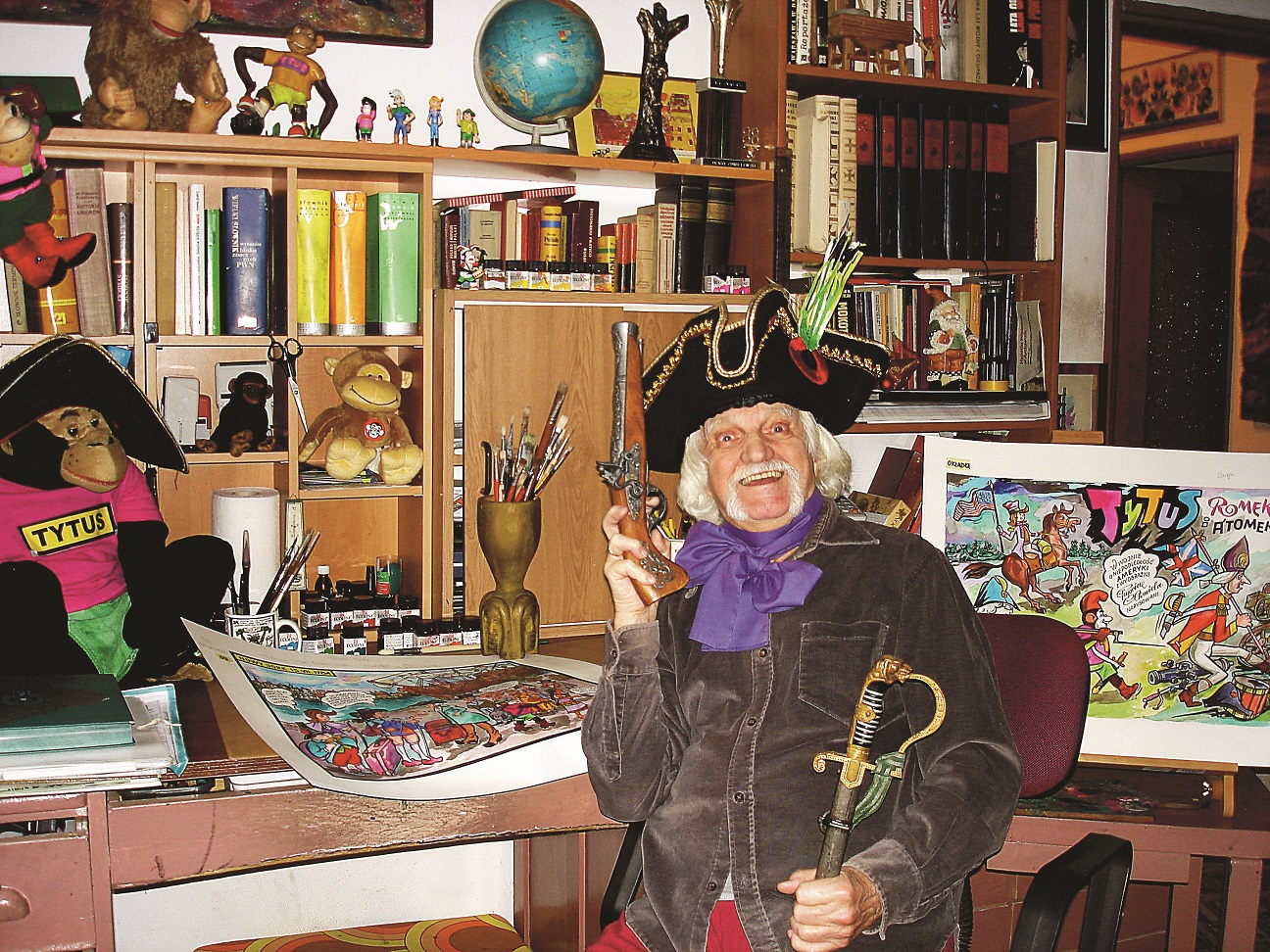
Courtesy of the Author.
Henryk Jerzy Chmielewski
[Papcio Chmiel] , 1923 - 2021
(Author, Illustrator)
Comic book writer, graphic artist and journalist; as a soldier of Armia Krajowa [Home Army] with code-name “Jupiter” he took part in the Warsaw Uprising (1944); illustrator for a teens magazine Świat Młodych; author of many comic book series, including the widely popular Tytus, Romek i A’Tomek [Tytus, Romek and A’Tomek], a well above 30-part comic book series about a talking chimpanzee who tries to become human; awarded the Gloria Artis Medal for Merit for Culture (Gold Class), the Warsaw Cross of the Uprising, the Commander’s Cross of the Order Polonia Restituta (for outstanding achievements in national culture) and the Order of the Smile, an international award (launched in Poland in 1968) given by children to people distinguished in their pro-children activities.
Source:
Official website (accessed: July 4, 2018).
Bio prepared by Magdalena Łokieć, University of Warsaw, magdalena.anna.lokiec@student.uw.edu.pl.
Sequels, Prequels and Spin-offs
Preceded by” “Romek i A’Tomek”, Świat młodych 85 (1957)–26 (1958).
Followed by: “Tytus, Romek i A’Tomek”, Świat młodych 102–103 (1959)–59 (1960).
Books I–XXXI.
Summary
Uncle Jan invites two Polish boys, Romek and A’Tomek, to spend their holidays in Australia. The invitation comes with a parcel containing a vehicle that needs to be assembled. After completing the construction, the boys name the vehicle “Ptyś” and invite their animal friend, Tytus — a talking chimpanzee they had rescued from a space lab — to join them on the expedition. The zoo’s CEO allows Tytus to go, and the group departs. Due to a malfunctioning compass, their first stop is Morocco instead of Iran. Their route takes them through Sub-Saharan Africa, where they have adventurous encounters with various wild animals, and Tytus’ talking cousins. After exposing the malpractice and fraud of a local ‘sorcerer’, they befriend the inhabitants of a small village. Later, bitten by a tsetse fly carrying sleeping sickness, they fall into a coma. A’Tomek dreams of being in the Greek army at Troy and exploring the myths he learnt in the fifth grade. Romek dreams of a flying carpet and ancient Egypt, where he becomes a pharaoh. Tytus dreams of getting a job at a weekly magazine, becoming invisible, capturing criminals and flying after being inflated with a gas. Eventually, the protagonists wake up before Christmas (as depicted in the Christmas issue of 23–26 Dec. 1958), and prepare to celebrate. They perform a Nativity play for their new African friends, who in return invite them to a New Year’s Eve costume party.
The further events in Africa refer to the Nobel Prize-winning writer Henryk Sienkiewicz’s novel W pustyni i w puszczy [In Desert and Wilderness] (1911), the action of which takes place in Africa in the 1880s. It is familiar to all Polish school children, as it is part of the list of obligatory school readings. On their journey from Africa to Australia, the boys stop to celebrate Tytus’ birthday on an islet that actually proves to be a whale. Flushed into the ocean, they are rescued by the crew of a ship involved in drug smuggling. The boys help the authorities expose and stop this practice, and are rewarded with tickets to Australia. En route, they find Ptyś drifting on the waves; however, they must reclaim it from the albatross that made a nest there. In Australia, they are captured by “Indians”, who turn out to be boys scouts. At the campfire, the scout troop leader recounts the story of James Cook’s 1770 expedition aboard the Endeavour (which was illustrated by a different cartoonist, Mieczysław Kościelniak; thus, the style of the story within the story changed), and the history of Australia under British rule. Having listened to these stories, the boys dream of the gold rush. Later, they continue their journey to visit Uncle Jan. Ptyś goes missing again and the boys try to find it using a metal detector. Instead of their vehicle, they discover an old train covered in sand. In it, they find a small chest. They think a treasure is hidden inside and, indeed, it consists of old letters, written by a certain Paweł Edmund Strzelecki, a great 19th-century traveller, explorer and philanthropist. Tytus starts the train, and the boys go to Cracow (Queensland, AUT), where they meet members of the Polish community and, finally, Uncle Jan.
Analysis
Instalments 1–86 of 1958 were the first series of comic strips entitled Tytus, Romek i A’Tomek. This is the most popular and longest-published Polish comic series. The previous series of instalments, set in space, was entitled Romek and A’Tomek, and the character of Tytus, a talking chimpanzee locked in a lab on board a space rocket, was introduced in instalment 2 (Świat Młodych 86 of 1957). This series of 86 comic strips was not given a subtitle until 2024, when it was named Travel to Australia.*
Although the storyline depicts an adventurous journey from Poland through Africa to Australia aboard a vehicle called Ptyś, it also includes many references to classical antiquity. These references appear on three levels: visual, linguistic, and through the use of a dream device that places the action in the ancient world of myths and historical events. Chmielewski was a graduate of a pre-war humanistic gymnasium where Latin was compulsory, and he acquired a knowledge of the classics that was usual in his generation, but (due to the shrinking of classical languages’ teaching under communism in Poland) which would be considered advanced today. Thus, his characters use not only everyday words that derive from Latin, but also Latin-originated exclamations instead of “oh my goodness”. In instalment three, A’Tomek exclaims, “Perbaco! We’ve completely forgotten about Tytus!” and later “Materdeju! This is not Tytus! We kidnapped an uneducated monkey!” which are polonised exclamations of per Bacchum (by Jove!, good heavens!) and mater dei (Holy Mother!, good heavens!), respectively. These exclamations do not actually exist in Polish in this form and were ‘invented’ by the author. Similarly, in instalment 5, A’Tomek exclaims: “By Zeus! Who put a tin of sprats next to the compass? The needle points to the tinned fish instead of north.” In instalment 28 he also exclaims: “Zeus! Save me!” It’s worth noting that ‘by Zeus!’ is not an everyday exclamation, especially among children (the protagonist is about 11-year-old), so the author has purposely chosen these expressions to show that A’Tomek is quite educated for his age and that he is really interested in antiquity.
In instalments 25–30, references to classical antiquity serve as the setting for A’Tomek’s dream following his encounter with a tsetse fly. In his dream, the boy is at Troy, fighting alongside the Achaeans. The Trojans overwhelm them because Achilles, wounded in the heel, does not take part in the fighting. A’Tomek suggests building a wooden horse to help them win the war. However, inside the horse, he reads in his history textbook that the Trojans were slaughtered to the last man, and he does not want to be part of such a violence. Instead of a massacre, his new idea is to wake up the Trojans with music. The Achaeans play a concert in the main square, and everyone is happy. Outraged by A’Tomek’s alteration of the past, which could result in the rewriting of textbooks, History sentences him to exile on Cyclops Island. The clever boy deceives the Cyclops and escapes, then he encounters a Centaur, sails on a Persian vessel, incites the galley slaves to escape, faces the Labyrinth and the Sphinx. Later, the boy dreams that he takes part in the battle of Marathon and is ordered to inform the Athenians of the victory. In this way, he runs the first ever marathon and wins it in record time. His dream ends when the laurel wreath is about to be bestowed upon his temples.
Despite the Greek episode lasting only six instalments of three tiers each (10–13 panels), classical references are plentiful and function on several levels. The first level is a simple reference to the myths and mythical characters that are familiar from school curricula, such as the Trojan war, the encounter with Polyphemus, the Sphinx, or wandering through the Labyrinth. However, Chmielewski combines mythical and historical plots with contemporary elements, leading to absurd situations that surprise the reader with their unexpected contrasts, causing laughter and amusement. The better the reader knows mythology, the more fun they will have recognising familiar elements and discovering amusing alterations, such as the peaceful end to the ten-year conflict between the Achaeans and the Trojans, following the Aristotelian idea that music soothes manners and purifies the soul. Another funny, peaceful alteration to a classical tale is the story of Polyphemus. Having designed the Trojan horse, A’Tomek finds himself in Odysseus’ shoes again, he must face the man-devouring Cyclops. The boy is so terrified of being potentially eaten, that his soul partly leaves his body. And yet, he tricks the Cyclops by setting him a task rather than blinding him. A’Tomek makes a wager with Polyphemus that he would not lift a heavy rock, and, when he does, the boy escapes. For the second time, he appears to be as clever as Odysseus, or even smarter than him, as his trickery does not harm anyone. Amusing enrichment is also provided for the marathon run, which is given a contemporary perspective when A’Tomek is designated the messenger of the victory. On his road to Athens, he encounters a refreshment station for runners and must make a detour due to a one-way street sign. Fans also stand along the route, cheering him on, even though he is the only participant. Finally, his time is recorded, and he achieves a historic result: two clepsydras and 31 grains.
The second level of classical references is language. Greek names are used wherever possible; even A’Tomek is called by his Greek name, A’Tomos. Derivatives from Greek and puns can be seen in the text layer, while the drawings emphasise the Greek theme visually: for example, A’Tomek’s tunic is adorned with a meander border, a warrior wearing a lion’s skin, resembling Heracles, fights with a club at the Marathon and a “Marathon Housing Estate” sign features a reversed uppercase sigma instead of the letter ‘e’. Providing direct information within the dialogues is another way to create a reference, for instance, having seen a “Marathon Housing Estate” sign, A’Tomek exclaims: “Stop! The famous battle with the Persians is about to take place here! The year is 490 BC.” He is addressing his companions, but at the same time, the reader is also given the date of the battle, which they can easily remember while enjoying the humorous adventures.
* H. Chmielewski, Tytus, Romek i A’Tomek. Przygody nieznane, tom 1, Kraków: Ongrys, 2024, 59.
Further Reading
Jeziński, Marek and Marcin Lisiecki, eds., Tytus, Romek i A’Tomek i twórczość komiksowa Henryka J. Chmielewskiego, Toruń: Wydawnictwo Naukowe Uniwersytetu Mikołaja Kopernika w Toruniu, 2024.
Pszczolińska, Marta, “Classical Antiquity in Cartoons and Comics in Periodicals for Children and Teenagers in People’s Poland”, Clotho 2 (2025): 123–163.
Addenda
The entry presents the result of research conducted within the project “Classical Antiquity in Periodicals for Children and Young Adults in Polish People’s Republic (PRL) – Classical Education, Promotion of Political Ideology, or Expression of Resistance? Changes in the Reception of Classics in the PRL from 1945 to 1989,” funded by the National Science Centre (Narodowe Centrum Nauki) Preludium grant no. 2022/45/N/HS2/00549, and led by Marta Pszczolińska at the Faculty of “Artes Liberales” at the University of Warsaw.