
arrow_upward

Dookoła Świata

Look for Virgo [Szukajcie panny]

YEAR: 1959

COUNTRY: Poland

chat Submit error

Cateogry icon

Title of the work

Look for Virgo [Szukajcie panny]

Country of the First Edition

Country/countries of popularity

Poland

Original Language

Polish

First Edition Date

1959

First Edition Details

[Anonymous], “Szukajcie panny”, Dookoła świata 312–313 (1959): 9, 13, 17, 29, 33, 41.

ISBN

ISSN: 0012-5458

Official Website

Genre

Article in a periodical*

Target Audience

Crossover (teenagers, young adults)

Cover
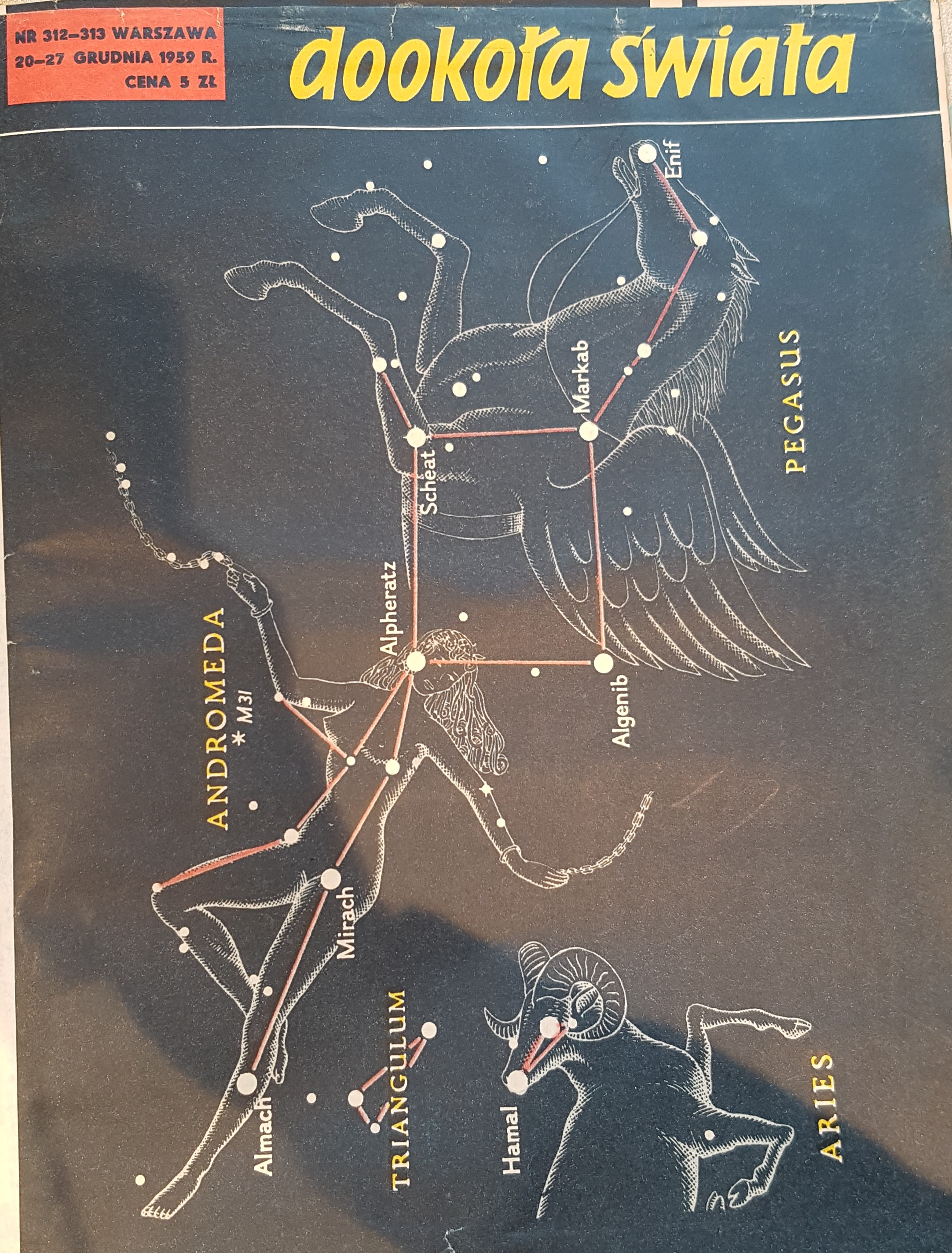
Cover with kind permission of the copyright holder for the magazine Dookoła Świata (1954–1976).


Author of the Entry:

Marta Pszczolińska, University of Warsaw, m.pszczolinska@al.uw.edu.pl

Peer-reviewer of the Entry:

Katarzyna Marciniak, University of Warsaw, kamar@al.uw.edu.pl 

Elżbieta Olechowska, University of Warsaw, elzbieta.olechowska@gmail.com
Male portrait

Dookoła Świata , 1954 - 1976
(Publisher)

Dookoła świata [Around the World] magazine launched its preprint issue in December 1953, the same year Stalin died. It was intended to be a sort of travel magazine and formally started with issue 1 in January 1954 and folded in 1976. From the very beginning, the magazine was considered by its readers in Communist Poland as “a window to the external world”. It published articles from the other side of the Iron Curtain, when passports and permissions for travel abroad were rarely granted, effectively preventing people from exploring the world. It features reports from anywhere in the world and novels in installments, novellas and/or short stories, interviews, articles about art, essays, fun facts, and many more materials, attractive to the young reader.

Despite the large print run (around 350K copies), demand for the magazine was much higher, and people queued up, hoping that there would be enough copies for them to buy (cf. Polska Kronika Filmowa PKF  9/54, 7:14–8:57).


Bio prepared by Marta Pszczolińska, University of Warsaw, m.pszczolinska@al.uw.edu.pl


Summary

“Szukajcie panny” focuses on presenting selected constellations alongside the associated star myths in order to create a kind of celestial primer. The whole is divided into six illustrated parts, appearing across the issue as it’s leading theme. 

The first part, Kudłata kochanka [The Furry Mistress], recounts the myth of Callisto, who was transformed into a she-bear because of her love affair with Zeus, as the character associated with Ursa Maior. The text also mentions Cynosura, Zeus’ nurse as associated with Ursa Minor. The author discusses other constellations and stars, as well as their presence in culture, also referring to Draco, the Hesperides and Hermes. 

The second part, entitled Czy Lutnia nas zgubi? [Will the Lyre Ruin Us?], depicts the constellation of Hercules, its stars, neighbourhood, and future prospects. Subsequently, the author recounts the myth of Orpheus, his journey to the Underworld, and his tragic death, after which his lyre was hung in the sky.

The next part is called Wieloryb z sardynką [The Whale with the Sardine] and refers to the constellations of Cetus and Pisces. No myth follows the description. Wszystkiemu winna mama Kasjopea [It’s All Mum Cassiopeia’s Fault]* depicts that part of the sky where the Greeks placed characters from Perseus and Andromeda myth, i.e., the Cepheus, Cassiopeia, Cetus, Perseus, Pegasus, and Andromeda constellations. Olbrzym z maczugą [A Giant with a Club] depicts the Orion constellation, which resembles a “gigantic Orion pointing with his club at the attacking Bull (Taurus)” (p. 33), but does not tell the reader anything about this mythical character. 

The last part is titled Bliźnięta z łabędziego jaja [The Twins Born from a Swan Egg]. It presents the Gemini constellation, beginning with a quote from Pan Tadeusz [Sir Thaddeus] by the Polish Romantic poet, Adam Mickiewicz (1798–1855), and then recounting the myth of the extraordinary origins and exploits of Castor and Pollux. It ends with a description of the constellation and its surroundings.


* This title alludes to a famous song Put the Blame on Mame from the 1946 Charles Vidor’s film Gilda featuring Rita Hayworth’ (1918–1987). Sława Przybylska (b. 1931) sung its Polish version,  Winna była Mama

Analysis

When the issue was published at the end of 1959, the Space Race era was ongoing. In 1957, the dog Laika was successfully launched into space, and in 1960, Belka and Strelka were launched and returned. In 1961, the Russian Yuri Gagarin became the first cosmonaut. The sky was no longer the limit, so aeronautics, aerospace and the cosmos were very popular themes, especially among young people. Dookoła świata followed this trend with this mini cycle distributed throughout the pages of the issue; its cover was designed to look like the night sky, featuring the constellations of Pegasus, Andromeda, Triangulum, and Aries, with their brightest stars marked and labelled. The texts in the issue have a strict, informative, and educational focus. They aim to present knowledge of stars, constellations and the cosmos, combining this with the popularisation of Greek myths associated with particular parts of the celestial sphere. The proportion of the myths to the depictions of the stars varies, but scientific accounts actually prevail over mythical tales.

The author briefly evokes star myths, providing only basic information. For example, the myth of Callisto is summarised in just four sentences: the story of an Arcadian princess and a maid in Artemis’ retinue turned into a she-bear as a punishment for her love affair with Zeus and then transferred by him to the sky. While focusing on Hercules, no mythical reference to the hero is mentioned. Instead, the author presents the myth of Orpheus’ katabasis and adds that it is his lyre which the gods suspended in the firmament. The myth of Perseus is slightly longer, but at the same time vague. The author depicts the “dramatic situation in the sky” (following Aratus’ description): Andromeda waiting for Cetus, with Cepheus and Cassiopeia nearby, and Perseus on Pegasus rescuing her by slaying Cetus (p. 29). However, such a description, lively narrated, may confuse the young reader. They might assume that it mirrors the myth accurately, when in fact Pegasus’ role in the course of the mythical event is totally different. Pegasus is only associated with Perseus through the death of Medusa at his hands, and not as his mythical stallion. The anonymous author does not mention Bellerophon as the rider, nor do they explain Pegasus’ origin. Given that an ancient source, namely Aratus, is referred to, readers unfamiliar with the myth may consider Pegasus to be Perseus’ mount, inseparable from his mythical adventures. Similar imprecision accompanies the myth of the Dioscuri. The land of Laconia is called Laoconia, which may be a typo or a sign of carelessness. In this version of the myth, the author depicts the Dioscuri and their twin sisters as mortal beings who originated from the swan egg given to the childless Tyndareus and Leda by Hermes. The twin brothers Castor and Pollux are here not only depicted as examples of heroic fighters against pirates and monsters, an activity that earned them the appreciation of Zeus, but also as role models of fraternal love. When Castor fell in battle, it is said that Pollux did not want to live any longer, which was why Zeus transferred them both among the stars to shine as the Gemini constellation. 

It is evident that the author and the editors prioritised the constellations over myths, as the maps of the sky accompany each part of “Szukajcie panny”. The myths are of secondary importance and they are only briefly outlined and do not dominate the data on the stars. However, the idea of exploring the connections between ancient Greek mythology and modern astronomical science was not widely popular during the Space Race era. As Dookoła świata was considered “a window onto the world” for Communist Poland, the article also broadened the cosmic perspective by referring to the mythical past and the culture of bygone eras.


Addenda

The entry presents the result of research conducted within the project “Classical Antiquity in Periodicals for Children and Young Adults in Polish People’s Republic (PRL) – Classical Education, Promotion of Political Ideology, or Expression of Resistance? Changes in the Reception of Classics in the PRL from 1945 to 1989,” funded by the National Science Centre (NCN) Preludium grant no 2022/45/N/HS2/00549.

Yellow cloud
Leaf pattern
Leaf pattern

Title of the work

Look for Virgo [Szukajcie panny]

Country of the First Edition

Country/countries of popularity

Poland

Original Language

Polish

First Edition Date

1959

First Edition Details

[Anonymous], “Szukajcie panny”, Dookoła świata 312–313 (1959): 9, 13, 17, 29, 33, 41.

ISBN

ISSN: 0012-5458

Official Website

Genre

Article in a periodical*

Target Audience

Crossover (teenagers, young adults)

Cover

Cover with kind permission of the copyright holder for the magazine Dookoła Świata (1954–1976).


Author of the Entry:

Marta Pszczolińska, University of Warsaw, m.pszczolinska@al.uw.edu.pl

Peer-reviewer of the Entry:

Katarzyna Marciniak, University of Warsaw, kamar@al.uw.edu.pl 

Elżbieta Olechowska, University of Warsaw, elzbieta.olechowska@gmail.com

Male portrait

Dookoła Świata (Publisher)

Dookoła świata [Around the World] magazine launched its preprint issue in December 1953, the same year Stalin died. It was intended to be a sort of travel magazine and formally started with issue 1 in January 1954 and folded in 1976. From the very beginning, the magazine was considered by its readers in Communist Poland as “a window to the external world”. It published articles from the other side of the Iron Curtain, when passports and permissions for travel abroad were rarely granted, effectively preventing people from exploring the world. It features reports from anywhere in the world and novels in installments, novellas and/or short stories, interviews, articles about art, essays, fun facts, and many more materials, attractive to the young reader.

Despite the large print run (around 350K copies), demand for the magazine was much higher, and people queued up, hoping that there would be enough copies for them to buy (cf. Polska Kronika Filmowa PKF  9/54, 7:14–8:57).


Bio prepared by Marta Pszczolińska, University of Warsaw, m.pszczolinska@al.uw.edu.pl


Summary

“Szukajcie panny” focuses on presenting selected constellations alongside the associated star myths in order to create a kind of celestial primer. The whole is divided into six illustrated parts, appearing across the issue as it’s leading theme. 

The first part, Kudłata kochanka [The Furry Mistress], recounts the myth of Callisto, who was transformed into a she-bear because of her love affair with Zeus, as the character associated with Ursa Maior. The text also mentions Cynosura, Zeus’ nurse as associated with Ursa Minor. The author discusses other constellations and stars, as well as their presence in culture, also referring to Draco, the Hesperides and Hermes. 

The second part, entitled Czy Lutnia nas zgubi? [Will the Lyre Ruin Us?], depicts the constellation of Hercules, its stars, neighbourhood, and future prospects. Subsequently, the author recounts the myth of Orpheus, his journey to the Underworld, and his tragic death, after which his lyre was hung in the sky.

The next part is called Wieloryb z sardynką [The Whale with the Sardine] and refers to the constellations of Cetus and Pisces. No myth follows the description. Wszystkiemu winna mama Kasjopea [It’s All Mum Cassiopeia’s Fault]* depicts that part of the sky where the Greeks placed characters from Perseus and Andromeda myth, i.e., the Cepheus, Cassiopeia, Cetus, Perseus, Pegasus, and Andromeda constellations. Olbrzym z maczugą [A Giant with a Club] depicts the Orion constellation, which resembles a “gigantic Orion pointing with his club at the attacking Bull (Taurus)” (p. 33), but does not tell the reader anything about this mythical character. 

The last part is titled Bliźnięta z łabędziego jaja [The Twins Born from a Swan Egg]. It presents the Gemini constellation, beginning with a quote from Pan Tadeusz [Sir Thaddeus] by the Polish Romantic poet, Adam Mickiewicz (1798–1855), and then recounting the myth of the extraordinary origins and exploits of Castor and Pollux. It ends with a description of the constellation and its surroundings.


* This title alludes to a famous song Put the Blame on Mame from the 1946 Charles Vidor’s film Gilda featuring Rita Hayworth’ (1918–1987). Sława Przybylska (b. 1931) sung its Polish version,  Winna była Mama

Analysis

When the issue was published at the end of 1959, the Space Race era was ongoing. In 1957, the dog Laika was successfully launched into space, and in 1960, Belka and Strelka were launched and returned. In 1961, the Russian Yuri Gagarin became the first cosmonaut. The sky was no longer the limit, so aeronautics, aerospace and the cosmos were very popular themes, especially among young people. Dookoła świata followed this trend with this mini cycle distributed throughout the pages of the issue; its cover was designed to look like the night sky, featuring the constellations of Pegasus, Andromeda, Triangulum, and Aries, with their brightest stars marked and labelled. The texts in the issue have a strict, informative, and educational focus. They aim to present knowledge of stars, constellations and the cosmos, combining this with the popularisation of Greek myths associated with particular parts of the celestial sphere. The proportion of the myths to the depictions of the stars varies, but scientific accounts actually prevail over mythical tales.

The author briefly evokes star myths, providing only basic information. For example, the myth of Callisto is summarised in just four sentences: the story of an Arcadian princess and a maid in Artemis’ retinue turned into a she-bear as a punishment for her love affair with Zeus and then transferred by him to the sky. While focusing on Hercules, no mythical reference to the hero is mentioned. Instead, the author presents the myth of Orpheus’ katabasis and adds that it is his lyre which the gods suspended in the firmament. The myth of Perseus is slightly longer, but at the same time vague. The author depicts the “dramatic situation in the sky” (following Aratus’ description): Andromeda waiting for Cetus, with Cepheus and Cassiopeia nearby, and Perseus on Pegasus rescuing her by slaying Cetus (p. 29). However, such a description, lively narrated, may confuse the young reader. They might assume that it mirrors the myth accurately, when in fact Pegasus’ role in the course of the mythical event is totally different. Pegasus is only associated with Perseus through the death of Medusa at his hands, and not as his mythical stallion. The anonymous author does not mention Bellerophon as the rider, nor do they explain Pegasus’ origin. Given that an ancient source, namely Aratus, is referred to, readers unfamiliar with the myth may consider Pegasus to be Perseus’ mount, inseparable from his mythical adventures. Similar imprecision accompanies the myth of the Dioscuri. The land of Laconia is called Laoconia, which may be a typo or a sign of carelessness. In this version of the myth, the author depicts the Dioscuri and their twin sisters as mortal beings who originated from the swan egg given to the childless Tyndareus and Leda by Hermes. The twin brothers Castor and Pollux are here not only depicted as examples of heroic fighters against pirates and monsters, an activity that earned them the appreciation of Zeus, but also as role models of fraternal love. When Castor fell in battle, it is said that Pollux did not want to live any longer, which was why Zeus transferred them both among the stars to shine as the Gemini constellation. 

It is evident that the author and the editors prioritised the constellations over myths, as the maps of the sky accompany each part of “Szukajcie panny”. The myths are of secondary importance and they are only briefly outlined and do not dominate the data on the stars. However, the idea of exploring the connections between ancient Greek mythology and modern astronomical science was not widely popular during the Space Race era. As Dookoła świata was considered “a window onto the world” for Communist Poland, the article also broadened the cosmic perspective by referring to the mythical past and the culture of bygone eras.


Addenda

The entry presents the result of research conducted within the project “Classical Antiquity in Periodicals for Children and Young Adults in Polish People’s Republic (PRL) – Classical Education, Promotion of Political Ideology, or Expression of Resistance? Changes in the Reception of Classics in the PRL from 1945 to 1989,” funded by the National Science Centre (NCN) Preludium grant no 2022/45/N/HS2/00549.

Yellow cloud